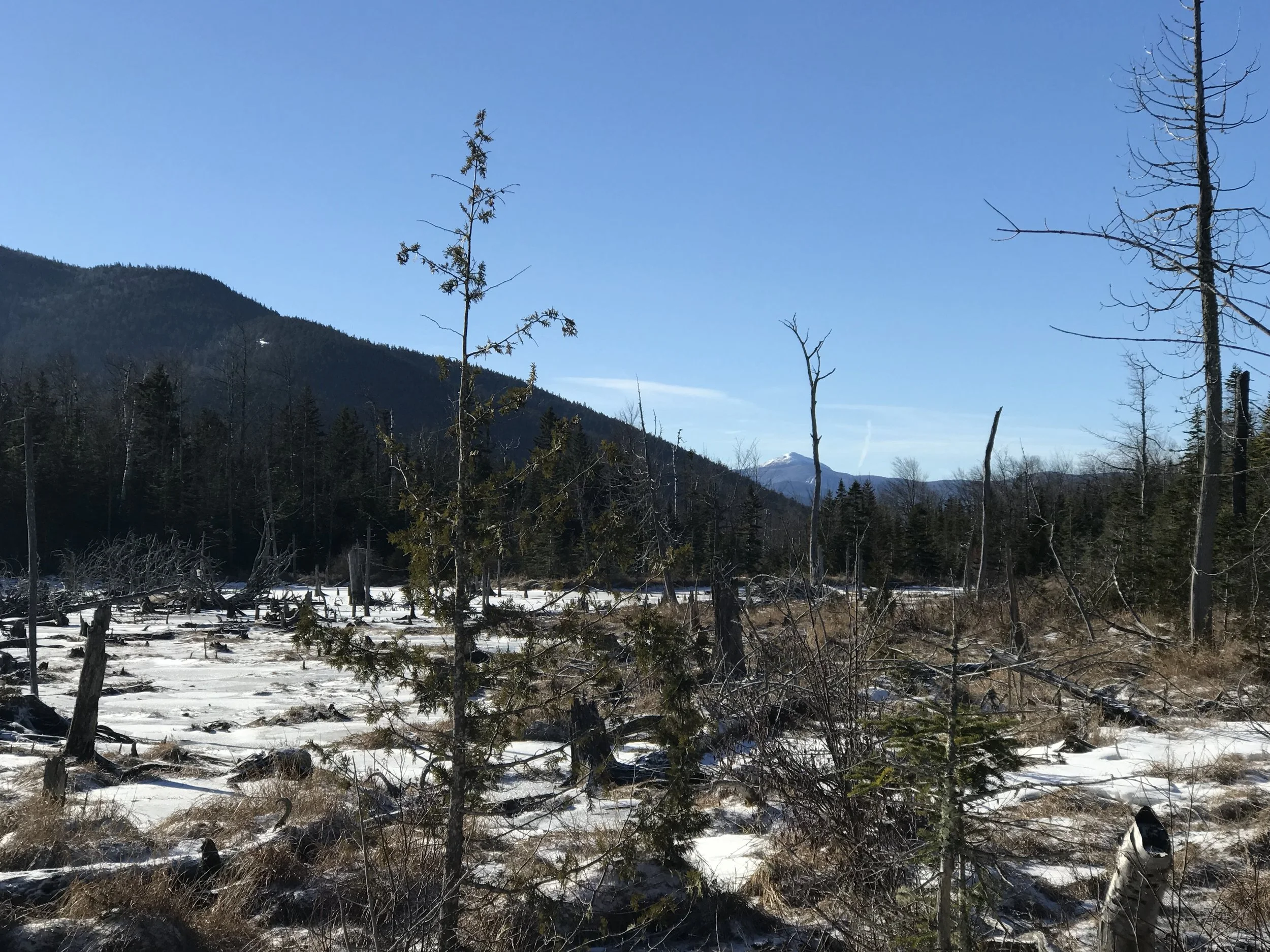
The Bottomland
A short story
“I haven’t seen a trail marker in a while,” Jessica says.
I plant my ski poles, study the gray tree trunks along the trail ahead. Then I turn around and look uphill past Jessica. Nothing. The orange blazes are gone. It’s just the furrow of the snowshoe track we’ve been following and blank, gray tree trunks as far as I can see.
I assumed the snowshoe tracks followed the trail, but apparently not.
“You’re right,” I say.
Jessica looks cold and tired. So am I, if I’m being honest. The hike’s been harder than I expected or advertised. The snow’s deep, and the temp’s been dropping all afternoon. The uphills are brutal, and we stiffen up and shiver on the downhills and flats.
“Let’s keep going,” I say. “I’m sure we’re still on the trail.”
I’m not as confident as I sound. I thought we were on the trail that takes us back to the car. I’ve hiked that trail more times than I can count. But we’ve been going downhill for too long, and something about this hillside feels weirdly unfamiliar.
I tell myself it’s because I’m anxious. Jessica and I became friends when we worked together. She was extraordinary and I was sufficient, and I was hoping to impress her with my outdoorsman expertise.
We stomp downhill in our snowshoes, looking up and down the trail for blazes. I’m moving fast and hoping hard. But there’s nothing.
“If this isn’t the trail, where were these people going?” Jessica asks.
“It must lead to a road or a trail,” I say.
“Or a couple dead hikers,” Jessica says, smiles. I laugh, not just because it’s funny but because the smile tells me she’s still okay.
“Let’s go a little farther,” I say. “If we don’t find anything, we’ll double back.”
I could be making the classic lost hiker mistake. Convince yourself you’re on the right path when it’s obvious you’re not and get yourself even more lost. But retracing all that distance feels daunting. I’m cold and I’m exhausted. This path needs to take us to the car.
Jessica nods. We continue downhill.
The snowshoe track finally levels, enters a stand of massive oak trees. The trunks are the size of boilers, the branches thick as trees themselves. I’ve never seen a stand of old growth like this in Hi Tor. I had no idea it even existed.
Which means we’re definitely off the trail.
“These must be hundreds of years old,” Jessica says.
I still can’t face climbing back up the hill, so I snowshoe through the stand. The snowshoe track follows the trough of a creek out of the woods onto an empty bottomland. There are ranks of dead trees as far as we can see. The snowshoe tracks head into the tangles of cattails and black spruce. The sky is gray as ash.
I look at my watch. 3:37 PM. Sunset’s only an hour away.
“What’s that?” Jessica asks.
She’s pointing at the root ball of an overturned tree just ahead of us. It looks like a fingerless hand clawing up through the snow. But that’s not what she’s looking at.
There’s something on the ground beneath it.
A deer.
It’s lying on its side. Our snowshoes creak as we approach and I’m sure it’s going to scramble to its feet and bound away. But it doesn’t move.
It’s a buck. I count four points on the antler that’s not sunk in the snow. It looks like it lay down no more than a few minutes ago.
Its left eye stares up me. Gray and empty.
It’s dead.
“I’m not Daniel Boone,” Jessica says, “but shouldn’t there be tracks?”
She’s right. There’s smooth snow in every direction.
“Maybe it’s been here a while,” I say.
“If the tracks are snowed over, wouldn’t the deer be too?” Jessica asks.
She’s right again.
So much for impressing her with my outdoorsman mystique.
I kneel and take my glove off, lay my hand on the buck’s back hip. I expect it to be as cold as everything else. But it’s not.
“It’s still warm, isn’t it?” Jessica says.
I just nod.
“What the hell is going on?” she asks.
“I don’t know,” I say.
What I do know is that I want to get the hell out of here.
“I think it’s time to backtrack,” I say.
Jessica nods. She looks worried.
So am I.
We snowshoe through the stand of oaks, start up the hill. We watch for blazes as we climb, but it’s blank trees all the way to the top. We’re both breathing hard when the track levels onto the hilltop, but I’m not as warm as I should be after the exertion.
I remember an orange blaze where we stopped to look at the southern reach of Canandaigua Lake. That’s where we picked up the snowshoe tracks, and it wasn’t far from here.
“We’re close,” I say.
Jessica’s breath plumes in the cold, and I can sense her shivering beneath her red parka. She nods again, tries to smile but fails.
We study every tree as we hike. I wait for the trail to open on the campsite with the lake view, but the trail starts downhill again. I tell myself the hilltop isn’t perfectly flat, that the clearing is just ahead. But we keep going down.
“This isn’t right,” Jessica says.
I stop and turn around.
“You don’t remember this hill either,” I say.
“Did we miss a turnoff?”
“I don’t see how,” I say. But my thoughts are as thick as wet concrete in this cold. What if we did miss it?
“We go back, or we go forward,” Jessica says.
“We must have come through here,” I decide.
So we continue downhill. I keep hoping it’ll flatten out and we’ll break out onto the overlook. But the track keeps descending.
The trees around us are black as cast iron by the time the trail finally levels out. We’ve lost too much elevation to be anywhere near the overlook. But we keep going because that’s all we can do.
We break into the open. For a second I think it’s the overlook, but it’s another bottomland full of dead trees.
This is all wrong.
Jessica’s face is slashed with white. The beginnings of frostbite. But that’s going to be the least of our worries if we don’t get the hell out of here.
She takes her phone out, shakes her head.
“It’s dead,” she says. “What about yours?”
“It must be the cold,” I say as I reach into my pocket. I pull out my phone and the screen lights up. The lock screen is a picture of a sunset on Seneca Lake in the summertime. It only makes me colder.
“Do you have any bars?” Jessica asks.
“No,” I say.
“Is it an iPhone?”
I nod.
“The SOS feature works without reception,” Jessica says.
My thoughts are slow, like they’re turning into slush, and I don’t respond.
“Can you use the SOS?”
Her suggestion finally seeps into the front of my mind, and I understand. I promised myself I’d never call for a rescue. Rescues are for amateurs and idiots. If I need to be rescued, I don’t belong in the woods.
But the thought of someone looking for us is like a warmth cutting through the cold. I imagine the headlight of a snowmobile cutting through the dark, a warm diner in Naples, hot coffee, food.
I push the buttons to bring up the SOS screen.
And my phone goes black.
I stare at it, speechless. Jessica leans in next to me, her breath pluming like exhaust smoke. I try to turn the phone back on, but my fingers are stiff as frozen clay. Jessica takes the phone from me, tries it herself.
“We’re screwed,” she finally says.
We stand there with the cold weighing down on us as the last light seeps away.
“I’m sorry,” I finally say.
“It’s not your fault,” Jessica says, “but we need to keep moving.”
We put on our headlamps and start across the bottomland. The snow is deeper, the trail less packed, but the exertion keeps me from freezing. I just don’t know how much longer I can keep it up. We ate the last of our trail food at the overlook.
The wash of light from my headlamp pulls something from the dark ahead. It looks like a huge tractor tire sticking up out of the snow.
It’s the root ball of a fallen tree.
And something is lying beneath it.
I feel like my stomach is reaching up into my throat choking me as I step closer. The creak of Jessica’s snowshoes stops behind me. She’s seen it too.
I don’t want to see what I’m seeing. But it’s right there in the blur of light from my headlamp. A buck with four points on its right antler, lying on its side in the snow.
“This is impossible,” Jessica says.
I don’t say anything because she’s right. We were heading away from here. Did we loop back around and cross the same bottomland from the other side?
I turn off my headlamp, peer ahead into the dark. I can see the black mass of a hillside ahead, like a dark cliff looming over us.
The same hill we descended and climbed again.
The cold claws its way through my parka into my back, and I shudder. It feels like a sob.
Jessica stares at me, her face bone white behind the glare of her headlamp. Then she pushes past me, heads toward the hillside. I follow.
We pass through the oak stand beneath the arched branches. It’s like snowshoeing through a train tunnel. The trail starts climbing. We move quickly because our fear is stronger than our exhaustion. But I’m not warming up. The heavy cold extinguishes whatever heat I’m generating from the climb.
My right foot is slushing around in my boot, and it takes me a minute to realize the laces are untied. My fingers aren’t doing what I want them to do, and I work hard to retie it. I look up and see Jessica’s headlamp on the trail above me. She isn’t moving. I assume she’s just waiting for me, but as I get closer, she looks back at me and shakes her head.
Something is wrong.
She looks at me like someone backed into a corner by a rabid dog. She turns and shines her headlight up the trail. There is smooth, undisturbed snow as far as her light reaches.
The snowshoe tracks we’ve been following end where we’re standing.
Which is impossible. We’ve been through here twice, and we haven’t felt a breath of wind or seen a single snowflake all day. How are they gone?
“We’re going to wake up any second, right?” Jessica says.
I step forward where the track should be, sink past my knees like I’m breaking fresh trail. If the track was covered over, the packed base we made would still be underneath.
It’s like the track never existed.
“What the hell is happening?” Jessica asks.
I don’t answer because I’m as dumbfounded as she is. We stand there in the dark and the cold, unable to speak.
“We’re not in the middle of the wilderness,” Jessica finally says. “We can’t be that far from a road.”
She’s suggesting we leave the track and bushwhack through the woods. Normally, I would never even consider that. It’s a classic way hikers get into trouble. But this situation is anything but normal.
I struggle to picture the map in my head. “Italy Valley Road should be to the south, and Basset Road should be east,” I finally say. “We have to be somewhere in the triangle between that intersection.”
“What’s in the other directions?” Jessica asks.
“A lot more distance than we can cover before our headlamps die,” I say.
“And before we die,” Jessica says, her breath rippling with cold and fear. “Which way then?”
I take out my compass, wait as the needle wobbles and finally settles on north.
“We parked on Basset,” I say. “Let’s head east.”
I point to the right and set off. Jessica follows.
We sink past our knees with each step as we fight our way across the hillside. I turn uphill, hoping the extra effort will warm me, but it feels like my legs are made of lead. I stop to check the compass, shudder with cold. Jessica stares off into woods like she’s half asleep. We start moving again. This time I angle downhill. It’s the only thing we can do if we want to keep moving.
I imagine the trees breaking onto a road, the lighted windows of a house in the distance, the warmth inside. I tell myself we’ll be okay.
I’m anything but okay right now.
I can’t feel my feet, can’t even wriggle my toes, and my fingers are stiff as marble. I concentrate on putting one foot in front of the other, fall deeper and deeper into myself. My thoughts meander like I’m dreaming. The woods dissolve into a numb twilight.
At some point I feel my breath burning, realize we’re moving uphill. I check the compass, realize we’ve veered south. I peer east through the cloud of my breath, try to control my shuddering.
At the edge of my lamplight, the black tree trunks fall into a line as straight as a stockade.
My shadow bloats and stretches across the snow as Jessica comes up behind me.
“A road,” I say. My voice is hoarse as a dying cricket.
I push uphill toward the cut, but the closer I get, the farther trees drift apart, and I realize there is no cut. Just more wooded hillside.
I’m too numb to be disappointed.
Jessica’s face is as pale as a porcelain doll. She looks sad, tries to smile, shakes her head instead.
We keep going uphill a few steps at a time, resting more than we’re climbing. I keep praying for the hilltop, but the trees keep marching uphill. The cold gets heavier and heavier, slows me down a little more with each step. I’ve never been this cold, never been unable to warm myself up by moving.
The cold finds its way to my spine, seeps into my chest. It’s only then I realize we’ve reached the top of the hill.
Jessica’s hunched over her ski poles, shuffling her snowshoes forward like an old lady with a walker. Her headlamp is yellow and feeble. I want to say something encouraging, but my tongue feels like a slab of frozen meat.
I want to say I’m sorry.
Something drags my right foot backwards and I pitch forward. I feel the burn of snow on my face, the punch of my ski pole driving into my ribs. I cry out but all that comes out is gasp.
I push myself to my elbows, turn onto my side so I can see my feet in the light of my headlamp. My snowshoe is twisted sideways beneath a fallen branch. It’s no thicker than a finger but I’m weak and shuddering and still sinking into the snow and I can’t pull my leg free.
I look around for Jessica, see a light hovering in the distance ahead. It’s yellow and feeble and it sways like someone walking. When did she pass me?
I wrestle with the branch, crawl forward. My snowshoe pops free. I plant my ski poles in the snow, push myself to my knees, kneel there shuddering. I push myself up enough to get my right snowshoe under me. I want to rest again but my right leg is already burning with exhaustion. I try to stand, rise halfway, collapse back onto my knee.
I pull my ski poles out of the deep snow and plant them on the track that Jessica packed down in front of me, push upward with everything I have.
Now I have both snowshoes under me, but I need to stand. My legs quaver, convulse. If I don’t make it to my feet now, I don’t think I ever will.
I fight to my fight like a power-lifter beneath a massively-weighted barbell.
I slide my right foot forward, then my left, follow Jessica’s tracks as they start up another rise. I can’t expect it to stay flat, but I’m devastated all the same. I’m so weak, so cold, so tired. I want to cry.
The hill tops out quickly. Thank God. I wouldn’t have made it if it was higher. I realize I haven’t seen Jessica’s light, pray that she’s okay.
Then I’m floundering downhill again. A creek bed splits open on my right. My headlamp sweeps across snow-covered boulders as round and smooth as tumors, finds a massive tree just ahead. And just beyond it, a crease in the snow intersecting with Jessica’s snowshoe track.
This jostles me out of my stupor. I shuffle forward faster than I thought I could move, find a packed trail merging with the powdery furrow Jessica left behind her.
I go dizzy with hope. It feels like warm bathwater seeping through my chest and shoulders.
It’s wider and more beaten down to the right, so I go that way, hoping it was Jessica who deepened it. I sweep my headlamp from tree to tree, searching for a blaze on the thick trunks, but they’re all blank.
Then I stop.
Because this place feels familiar.
It’s so hard to focus, so hard to drag a thought from my mind. I’m in a grove of ancient oaks. The branches look like muscled arms bent up at the elbows. The trail is a cavern beneath them.
I don’t understand. Some gravity I can’t escape keeps drawing us back here.
Us.
Where is Jessica?
I turn off my headlamp, hoping to see her light in the woods ahead, but it’s just a void of darkness. I turn my light back on, stumble up the trail croaking her name.
My light flashes against something red on the ground.
Jessica?
No, it’s too small. It looks like a child collapsed on the trail. I plant my poles, stumble forward.
A red coat.
My legs are stiff, and my fingers don’t do what I ask them, but I manage to pick it up, hold it in the fog of my lamplight. This feels important but my mind is so dark I can’t find any meaning for it.
It’s as inexplicable as everything else.
I tuck the coat beneath my arm and stumble forward. I’ve only gone a few steps when the edge of my light finds two small shapes on the trail, like dead birds fallen from the treetops. A a pair of gloves.
The realization finally fades into view.
These are Jessica’s gloves. Jessica’s coat.
Oh God.
I call out her name, but my voice is just a gasp. I stumble forward, emerge into the bottomland.
This time I’m not surprised.
My headlamp is fading. It’s dim enough now that I see a feeble light on the ground ahead seeping into the dead cattail blades beside the trail. I drag myself forward, find Jessica’s hat and headlamp in the snow.
Oh Jessica.
My heart wants to pound with fear, but it’s as numb as everything else.
A few steps further I see the clawed shape of the upturned root ball, the humped shape of the deer beneath it. Then my headlamp pulls a flicker of pink from beneath the root ball.
Another piece of clothing?
I shuffle past one of Jessica’s discarded snowshoes. My dying light bleeds across the trail ahead of me, drains slowly into the depression beneath the root ball.
It’s not a piece of clothing.
It’s not the dead deer.
Jessica sits slumped against the lattice of roots. She wears snow pants and a pink hiking shirt. One of her boots is half-buried in the snow next to her. She looks down at her hands, curled like talons in her lap. Her face is a white, expressionless mask.
I fall to my knees next to her. I take her by the shoulders and shaker her, whisper her name, but her body is rigid as marble. I take off a glove, touch her cheek.
Her skin is as cold and hard as ceramic.
It’s like she’s been sitting here for hours. But how? She wasn’t that far ahead of me.
Oh God, what do I do now?
I want to sit down next to her and never get up. I want this to end.
My headlamp is feeble yellow. It won’t be long before it goes completely dark. Before I go completely dark.
Then I see something on the trail ahead. A dark oval at the edge of my light.
I grip the roots and drag myself to my feet. It’s the bottom of a snowshoe, planted it in the snow toe first. And there’s a second snowshoe next to it, cocked to the side.
It looks like someone face-down on the trail.
But who?
I plant my ski poles, stagger up the trail. My light quavers across a man lying face down on the trail. He wears a pair of wool hiking pants and a blue thermal undershirt. I’m colder than I’ve ever been in my life, but my body goes even colder.
Because I’m wearing wool pants and a blue thermal undershirt.
I fall to my knees next to him, take ahold of his right arm. It’s stiff as an iron pipe. It’s like rolling a marble statue onto its back, but I finally manage.
And look into my own face.
I want to understand this, but my mind is as blank as my dead face and empty eyes. I should be horrified, but all I feel is the crushing cold. And a heavy certainty hardening through me like ice.
A quaver of light in the distance.
My first thought is someone come to rescue us, but it’s too late for that.
The light drifts toward me across the bottomland like dying firefly, finally stops next to the black column of a dead tree, hovers there like it’s waiting.
I see the shadow of a person beneath the light.
Jessica.
Her headlamp hovers in the dark like a will-o-wisp as I shuffle toward it. Then it turns, drifts weightlessly across the bottomland.
I follow it into the numb darkness.